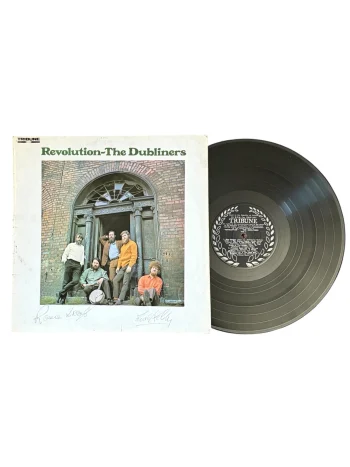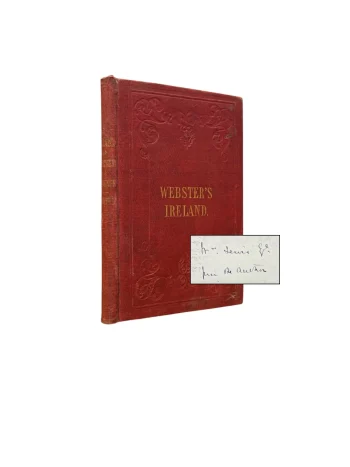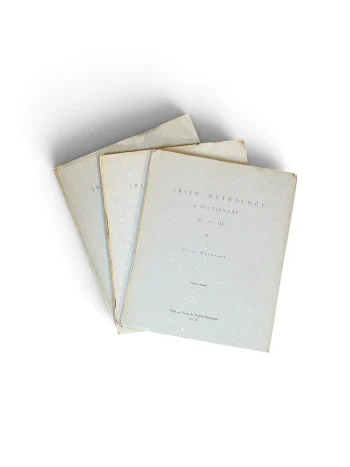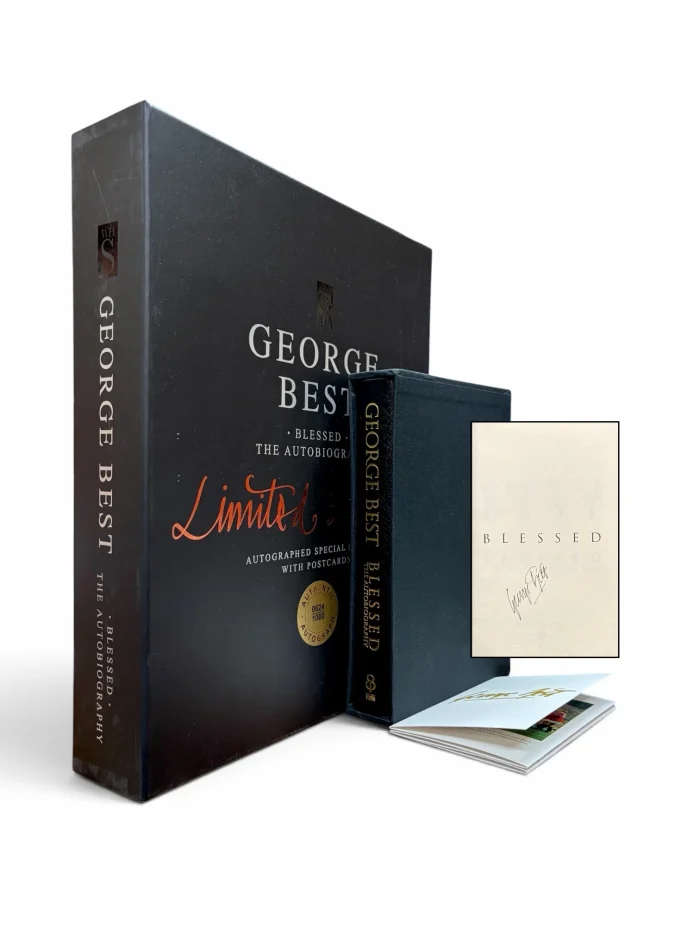
For collectors of rare books, a few handwritten words can transform an otherwise ordinary copy into something exceptional. Yet the terminology used to describe signed books is often misunderstood. A book may be signed, inscribed, or a presentation copy, and while these descriptions are sometimes used interchangeably, to a serious collector they can mean quite different things.
Understanding the distinction is important, particularly when assessing the rarity, provenance and value of a book.
What Is a Signed Book?
In its simplest form, a signed book is a copy bearing the author’s signature.
The signature may appear on the title-page, half-title, front free endpaper or on a specially inserted or tipped-in leaf. It might consist simply of the author’s name, without a dedication or any additional wording.
A straightforward signed copy is generally more desirable than an unsigned copy of the same edition, but its significance depends on several factors.
The scarcity of the author’s signature is particularly important. Some writers signed thousands of books during their lifetimes, while others rarely did so. The edition also matters. An author’s signature in a first edition of his or her most important work will normally be considerably more desirable than the same signature appearing in a later reprint.
Timing can also be significant. A book signed around the date of publication may have greater appeal than one signed decades later.
What Is an Inscribed Book?
An inscribed book contains something more than the author’s signature.
A typical inscription might read:
“To John, with best wishes, Seamus Heaney.”
At its simplest, this is a signed copy personalised to another person. But inscriptions can range from a few conventional words to lengthy and revealing messages.
For collectors, the crucial question is often: who was the recipient?
A routine inscription to an unknown reader may add relatively little beyond the value of the signature itself. An inscription to another important writer, artist, politician, friend or significant figure in the author’s life can transform the importance of the book.
The content of the inscription can matter just as much. A personal message referring to the work itself, a shared experience or an important event can provide evidence of relationships and circumstances that would otherwise have disappeared.
In exceptional cases, the inscription becomes an historical document in its own right.
What Is a Presentation Copy?
The term “presentation copy” should be used more carefully.
Traditionally, it describes a book presented by the author to another person, usually with an inscription indicating that the book was given rather than simply signed at a later date.
Phrases such as “With the author’s compliments” or “To [recipient], from the author” can provide evidence of presentation.
A presentation copy is particularly desirable when it was given at or shortly after publication. Such copies can offer a direct connection between the author, the recipient and the circumstances surrounding the appearance of the book.
Not every inscribed book, however, should automatically be described as a presentation copy. An author might sign and personalise a book many years after its publication without having originally presented that particular copy.
For collectors, that distinction matters.
What Is an Association Copy?
This is where signed and inscribed books can become especially interesting.
An association copy is a book that belonged to, or was presented to, someone with a meaningful connection to the author, the work or its subject.
Imagine, for example, a poet presenting a first edition to another major poet; a political leader giving a book to a close colleague; or an author inscribing a work to the person who inspired one of its characters.
The physical book then becomes evidence of a relationship.
Association copies are among the most fascinating books in collecting because their importance cannot necessarily be measured by edition or condition alone. Two apparently identical first editions may have dramatically different significance because of the identity of their original owners.
Does an Inscription Always Increase the Value?
No.
This is one of the great misconceptions surrounding signed books.
A signature or inscription can increase desirability, but collectors consider the entire book. Edition, condition, rarity, provenance, binding and the importance of the work all remain relevant.
The nature of the inscription is equally important.
A generic inscription to an unknown recipient may command only a modest premium. A significant presentation inscription to someone closely associated with the author can increase the value substantially.
At the highest level, collectors are not simply buying handwriting. They are buying context.
Signed First Editions
The combination most familiar to collectors is the signed first edition.
First editions represent the work as it originally appeared, while the author’s signature provides a direct physical connection with its creator. When the book is an important work and signed copies are scarce, the combination can be highly desirable.
But collectors should pay attention to terminology.
A “signed edition” is not necessarily a “signed first edition”. A later edition signed by the author is still signed, but it should not be confused with the first appearance of the work.
Similarly, some modern books are issued in large quantities as signed editions. These can certainly be collectable, but their availability may be very different from a first edition individually signed by an author who seldom signed books.
Provenance and Authenticity
With valuable signed material, provenance becomes increasingly important.
Collectors should consider how the book came onto the market, whether the signature is consistent with known examples and whether there is supporting evidence connecting the author with the recipient.
The inscription itself can provide clues. Handwriting, ink, wording, dates and even the location of the inscription within the book can all help establish its history.
For particularly important books, accompanying letters, correspondence, photographs, bookplates or a documented chain of ownership can greatly strengthen the provenance.
This is one reason why experienced booksellers look beyond the signature itself. The book and its history need to be considered together.
The Hierarchy Is Not Always Simple
It is tempting to imagine a straightforward progression:
Unsigned → Signed → Inscribed → Presentation → Association Copy
In broad terms, this can be useful, but collecting rarely works quite so neatly.
A scarce author’s simple signature in a major first edition may be considerably more valuable than a lengthy inscription in an unimportant later work. Equally, an apparently modest presentation copy may become highly significant once the recipient is identified.
Every copy has to be judged individually.
That individuality is one of the pleasures of collecting signed books.
A Book With a History
The appeal of a signed or inscribed book goes beyond monetary value.
An unsigned first edition is an object produced during the author’s lifetime. A copy held and signed by the author has an additional connection. A book presented by the author to a friend, colleague or fellow writer carries another layer of history again.
Occasionally, an inscription allows us to reconstruct a moment that took place decades or even centuries ago: who gave the book, who received it, and why.
For collectors, those connections can turn a book from an example of an edition into something unique.
At De Búrca Rare Books, we have handled signed, inscribed and presentation copies across Irish literature, history, politics and culture. When assessing such material, we consider not only the signature but the edition, inscription, recipient, provenance and the wider historical significance of the individual copy.
For the collector, that is ultimately the distinction that matters: not simply whether a book is signed, but the story behind the signature.